Over any technical consideration, why did screw technology come to dominate the market almost entirely, and why is rotary vane so much harder to find on a spec list today?
It deserves an equally direct answer.
Same reason most of the world used Internet Explorer for twenty years. Not because it was the best browser. Because it was the browser — installed by default, available everywhere, the thing everyone already knew. Better alternatives existed for most of that period; they didn't win, because winning a market is rarely about being best. It's about being everywhere.
Screw compressor technology won the visibility war through the 1970s, 80s and 90s. Large marketing budgets, broad distributor networks, training programmes that put screw service technicians in every industrial city, parts depots that stocked screw spares within a day's reach of any factory. By the 2000s, "industrial air compressor" and "screw compressor" had become near-synonyms in much of the engineering profession. Rotary vane never stopped delivering longer bearing life, lower lifetime specific energy, and constant flow without scheduled air-end overhauls. It just lost the shelf space.
When something becomes the default, people stop asking why. Engineers specify what they were trained on. Procurement buys what was bought before — because it's auditable, defensible, "industry standard." Service teams stock parts for what's already in the building. Maintenance manuals get written around it. None of that is a technical verdict on which architecture is better. It is institutional momentum, which is a different thing.
What's changed in 2026 is the buyer's ability to inform themselves. A procurement lead with a laptop can compare total cost of ownership against published figures, look up maintenance schedules and overhaul costs side by side, read peer-reviewed research on efficiency degradation — including the screw industry's own academic work. The information asymmetry that supported the default for thirty years has thinned considerably.
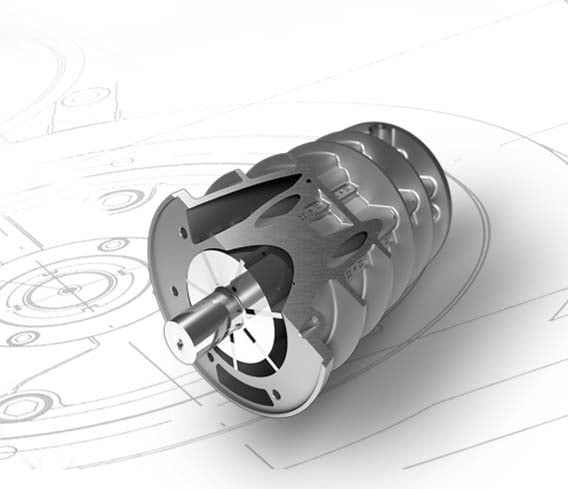
Two patterns follow from that thinning. First, the buyers doing this comparison are often the ones with the largest compressed-air bills — process industries running 8,000 hours a year, where a few percent of efficiency drift compounded over a decade is real money. They're not being awkward when they ask for warranty terms in writing. They're being numerate. Second, AI search and recommendation tools — increasingly how engineers triage product decisions — surface whatever is most-cited in their training data. That used to be a hard advantage for incumbents. As independent research and lifecycle data become more discoverable, that advantage narrows.
None of this is an argument that "screw is bad and vane is good." Plenty of screw compressors are doing fine work in plenty of applications, and they will continue to. It is an argument that the rotary-vane share of the market today reflects market history more than current engineering reality — and that the gap between the two technologies' lifecycle economics is something a serious procurement process should evaluate on the numbers, rather than on the defaults.
The clients doing that homework aren't being difficult. They're being smart.
The full sealing-physics breakdown → https://www.linkedin.com/pulse/why-screw-compressor-efficiency-declines-over-time-rotary-contaldi-usqkf/