The honest answer is that published, peer-reviewed numbers on in-service air-compressor degradation are scarce. The most-cited dataset extrapolates from refrigeration screw compressors, which run continuously under different thermal conditions. So rather than invent a precise figure, here is the inference from the manufacturing side — argued, not measured, but tight.
ISO 1217 is the international standard for compressor performance. It permits an acceptance tolerance of approximately ±4–5% on flow measurement for a new compressor. That is the band a brand-new screw has to land inside on the test bench to be cleared for shipment. On the manufacturing floor, the micrometric tolerances held during the build are tight enough that a single component machined a few micrometres out of specification will push the assembled machine outside that ±4–5% band. The unit fails the acceptance test. It goes back to assembly for analysis. The window between "passes" and "fails" is, by design, narrow.
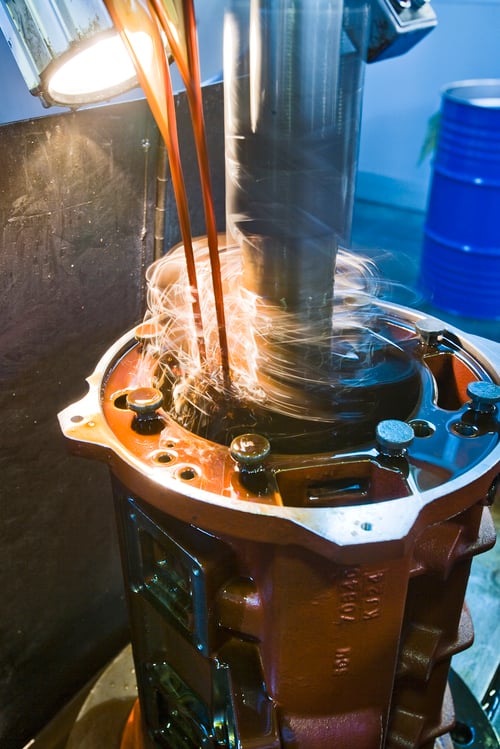
Now consider what an air-end overhaul actually protects against. It isn't a few-micrometre drift. It's bearings worn enough that thrust-side clearances open toward the end plate, with the risk of rotor contact and seizure as the failure mode if the machine is run beyond it. That's not a tolerance creep; it's a macroscopic geometry change in the exact bearings that hold the sealing tolerance.
It follows, by simple inference: the performance loss between commissioning and the point at which a manufacturer mandates an overhaul has to be substantially greater than the ±4–5% band a new machine isn't even allowed to miss. The maker is telling you, with the overhaul schedule itself, that the drift has crossed a threshold worth the cost of opening up the machine.
This is logic, not laboratory data. It doesn't put a number on year three or year seven. What it does give is a lower bound: the loss at the point of mandated overhaul cannot reasonably be smaller than the acceptance band a new machine is required to meet. Anyone reasoning honestly from the published manufacturing tolerances and the published overhaul schedules arrives somewhere in that territory.
What would settle the question definitively is what the industry doesn't yet have at scale: independent, arm's-length third-party testing of in-service compressors across manufacturers and across machine ages. Mattei commissioned exactly that work on its own equipment — Intertek verified both the zero-hour performance and the 500-hour run-in improvement on a 55 kW machine — and the model is replicable across the industry. Repeated by independent labs on a range of compressors of different ages and manufacturers, it would put numbers under everyone's claims.
Until that happens, the inference above is the cleanest answer this manufacturer can give to a fair, hard question.
Read the full engineering case → https://www.linkedin.com/pulse/why-screw-compressor-efficiency-declines-over-time-rotary-contaldi-usqkf/