Among the leakage paths inside a screw compressor, one is unavoidable by design: the blowhole, a geometric gap where the two rotor profiles mesh. It's a direct consequence of getting two helical rotors to interlock and turn — and it's present from day one.
The industry has fought it for decades: more sophisticated rotor profiles, tighter tolerances, better bearings. All of it has steadily reduced the blowhole's area. None of it has closed it, or can — it's inherent to the meshing geometry.
There's always a residual path from high pressure back to low.
And it doesn't stay put. As bearings wear and rotors shift, the clearances that define the blowhole open again, so the leak you paid precision-engineering money to minimise slowly grows back.
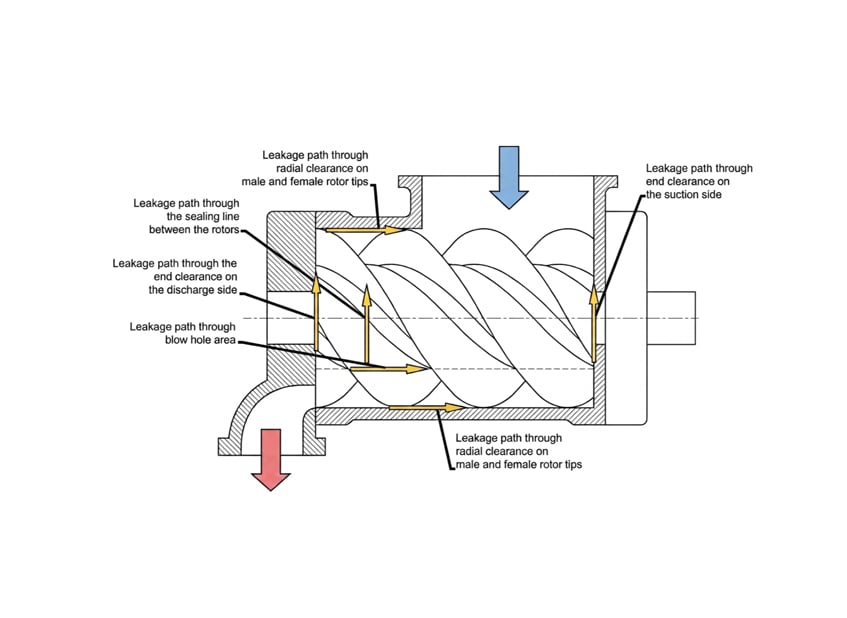
It's also not alone: high-pressure air slips past the rotor tips and flanks, and across the discharge end face — independent paths, every one a clearance, every one widening as the bearings wear.
No other rotary design carries so many simultaneous leakage paths.
Contrast that with a sealing film.
There's no meshing-rotor geometry, so there's no blowhole to minimise in the first place — and nothing that grows back.
You haven't managed an unavoidable leak; you've designed it out.
Read the full engineering case → https://www.linkedin.com/pulse/why-screw-compressor-efficiency-declines-over-time-rotary-contaldi-usqkf/